DJ set energy levels: what 1 to 10 means and how to use it
An energy level is a number from 1 to 10 for how intense a track feels: 1 is beatless and calm, 10 is a rare all-out monster. The scale was popularised by Mixed In Key, and DJs use it to shape a set: start low, build one level at a time, peak, and bring the room down on purpose. Here is what the numbers mean, how to plan with them, and how to get them into your Serato prep.
Plan a set with energy levels
-
Give every track a numberRun an analyser over your library, or rate tracks by hand as you listen. A rough number on every track beats a perfect number on a few.
-
Group your tracks into bandsLow (1 to 4) is listening and lounge music. Around 5 is where people start to dance, 6 is a comfortable groove, 7 is big and busy, and 8 and up is peak-time and festival material.
-
Match the band to your slotAn opening slot lives mostly at 4 to 6. A peak-time slot spends its time at 7 to 9. Playing the headliner’s band in the warm-up leaves nowhere to go.
-
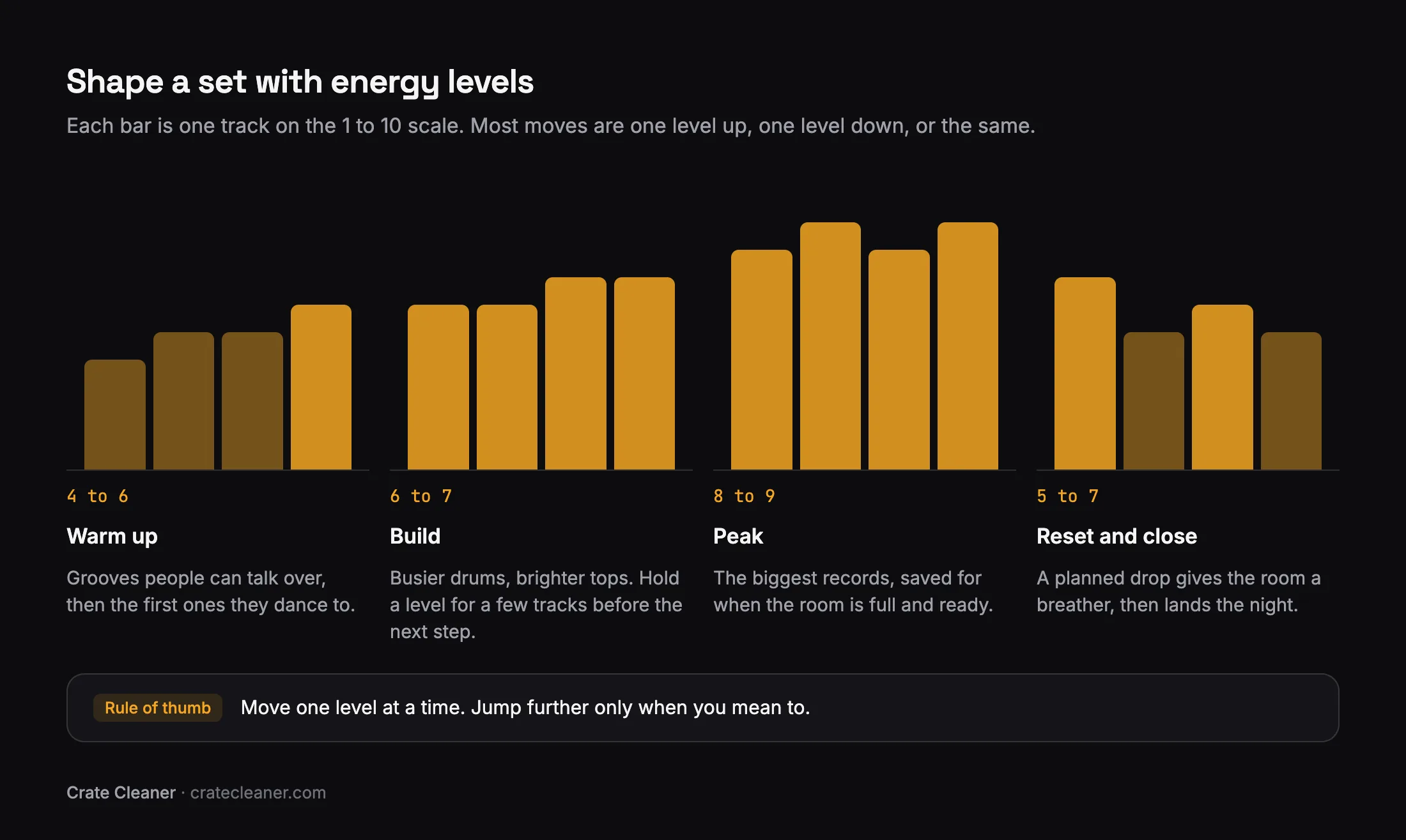
Move one level at a timeMost transitions go up one, down one or stay level. Holding a level for a few tracks before the next step lets the room catch up.
-
Drop on purposeAfter a run of peak records, a planned drop of a level or two gives the floor a breather and makes the next lift land harder. An accidental drop from 9 to 5 just empties it.
-
Check the number by earA single score cannot hear a long breakdown or a vocal intro. Audition the parts you will actually mix through before you trust the number.
What an energy level measures
An energy level describes how intense a track feels on a dancefloor, not how fast or loud it is. Analysers estimate it from the music itself: how busy and punchy the drums are, how much bright high-frequency content there is (hi-hats, shakers, sharp synths), how much weight sits in the low end, and how much the track drives from bar to bar.
Mixed In Key describes its scale roughly like this: 1 has no beat and won’t move a club, 2 to 4 is chillout and lounge, 5 is where people start dancing, 6 is easily danceable, 7 is high-energy party music, 8 is festival-anthem territory, and 9 and 10 are the rare climax records. Other tools use the same 1 to 10 range so the numbers line up.
Energy is not BPM, and it is not loudness
A 124 BPM deep house record can sit at 5 while a 100 BPM party track sits at 8. Tempo tells you whether two tracks can be beatmatched; energy tells you whether the move feels like a step up or a step down.
Loudness is the trap. A heavily mastered track is louder, but a loud ballad is still a ballad. Scoring energy from volume makes nearly everything in a modern library come out near the top of the scale, which tells you nothing. Crate Cleaner scores energy from the drums, low end, brightness and drive instead, so a quiet older record and a loud new one get judged on the music.
Three set shapes
- Opening (4 to 6). Start low while people arrive and talk, and edge up to 6 as the floor fills. Leave the big records for later.
- Peak time (7 to 9). Step up to 8 and hold there, with short dips to 7 so the 9s still feel big.
- Closing (6 down to 4). One last lift, then a gentle walk down so the night ends rather than stops.
Energy levels in Serato
Serato DJ Pro analyses BPM and key, but it does not score energy itself. There are two common ways to bring energy into a Serato set:
- An analyser that writes a tag. Some analysers can write the energy number into a tag field that Serato shows as a column. Check which field your analyser uses, show that column in Serato, and sort by it.
- Rate by hand. Serato DJ Pro 4 has a ratings column, and some DJs use it as an energy scale. It is slower, but it is your own judgement.
Either way, sort a crate by energy and then by BPM, and the next step up or down is usually a few rows away.
Energy levels in Crate Cleaner
Track Intelligence (Studio) scores every track from 1 to 10 on the same scale as Mixed In Key, from the music rather than the master volume. The scores stay in Crate Cleaner (they are not written into your files), and three features use them:
- Play Next uses energy for Lift, Hold and Drop: pick the playing track and choose a direction, and it lists only tracks that go that way. See how DJs know what to play next.
- Smart Crates templates each have an energy range (Warm Up 1 to 5, Build 4 to 7, Peak Time 7 to 10, Cool Down 1 to 4), and tracks closer to the middle of the range score higher. See how to set up smart crates.
- The Track Intelligence page lets you sort and filter your whole library by energy.
FAQ
Is energy level the same as BPM? No. BPM is tempo. Energy is how intense the track feels. A slow track can be high energy and a fast one can be calm, so check both.
What energy level should a warm-up set be? Mostly 4 to 6. Start where people can still talk, move to 5 and 6 as the floor fills, and avoid the 8s and 9s the next DJ will want.
Can Serato analyse energy levels? Serato DJ Pro analyses BPM and key but not energy. Use an analyser that writes energy into a tag Serato can show, or rate tracks by hand in Serato DJ Pro 4’s ratings column.
How accurate is automatic energy detection? Treat it as a strong hint. Analysers disagree by a level here and there, and none of them hears a long breakdown the way you do. A number on every track still makes a set far quicker to plan than none.
Should I move one energy level at a time? Most of the time. One step keeps the room with you. Bigger jumps work when you mean them, like a breather after the peak or a big record to wake the floor up.
Score energy across your whole library
Track Intelligence (Studio) rates every track 1 to 10 from the music. Play Next and Smart Crates use the scores to shape your sets. Try Crate Cleaner on the free plan first, no card required.